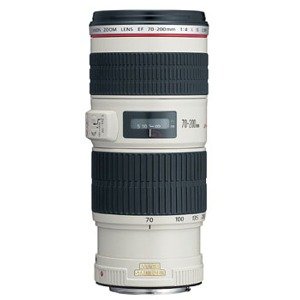
Buy Canon EF 70-200mm f/4 L IS USM Lens for Canon Digital SLR Cameras this month to take advantage of these low prices and have your package shipped to you right away.
Your friends will treasure this gift, whether it is for a family member or just for your own enjoyment. It is comforting to have a trusted source to put your trust in. The Canon EF 70-200mm f/4 L IS USM Lens for Canon Digital SLR Cameras will prove to be a superb choice.
Thank you for doing business with us for Canon EF 70-200mm f/4 L IS USM Lens for Canon Digital SLR Cameras.
Product Description
Canon EF 70-200mm f/4L IS USM lens offers the highest possible optical quality with no change in aperture over the full focal range of the lens. This allows photographers to set exposure at the widest aperture and zoom all the way through to 200mm without having to decrease shutter speed. Developed for use with a Canon SLR camera, this autofocus telephoto zoom lens offers optimized use with the Canon EOS series digital cameras. Of particular note, Canon has introduced an image stabilizer (IS) that adjusts to meet the demands of professional photography. IS reduces dramatically the image blur caused by camera shake. Gyro sensors detect unwanted vibrations, triggering the corresponding movement of a correcting lens group perpendicular to the optical axis. This alters the light path, returning the image to its correct position on the sensor or film plane. For shooting immobile subjects, Mode 1 corrects for movement in the image along both the horizontal and vertical axes. For shooting while panning horizontally to follow a moving subject, Mode 2 turns off vertical correction and prevents the effect of dragging the subject back through the frame. The lens' Ring-type USM employs ultra-sonic frequency vibrations to drive auto focus with unrivalled speed and near-silent operation. A powerful CPU and improved AF algorithm contribute to speed performance. The EF 70-200mm f/4L IS USM includes distance metering information, providing compatibility with the E-TTL II flash system of late model cameras such as the EOS-1D Mark II, EOS-1Ds Mark II, EOS 5D and EOS 400D. When used in conjunction with Canon's range of EX Speedlite flash units, the lens passes distance information to the flash algorithm for markedly improved flash exposure metering. Includes Lens hood and soft pouch
Price : $1,249.00
You Save : $951.00 (43%)

Product Details
- Item Weight: 1.7 pounds
- Shipping Weight: 3 pounds (View shipping rates and policies)
- Shipping: This item is also available for shipping to select countries outside the U.S.
- ASIN: B000I1X3W8
- Item model number: 1258B002
Price : $1,249.00
You Save : $951.00 (43%)
Customer Reviews
I have owned at one point or another all Canon's 70-200mm's with exception of the f/2.8 non-IS, along with a decent amount of other Canon L glass. Hence this review will be from the perspective of someone who may be deciding whether or not to add this piece of glass to their matured L collection or someone who is deciding on this lens versus another 70-200mm. If you are instead someone who has already decided on this lens and is looking for one last push to click the buy button, consider this, and the 25 reviews below it, as your green light.
First up, let's talk about the obvious good. This lens carries with it the most advanced IS drive to date, yielding an incredible 4-stops of stabilization. In real life, it is infact four full stops of stabilization. No kidding. For non-moving subjects, this lens becomes an effective 70-200mm f/1.4 as far as handholdability is concerned. When there is subject movement, however, realize that f/4 is still your true aperture and motion blur will be inherent.
As for the not-so-obvious good, this 70-200mm version has the highest image quality out of any of the other 70-200mm's. CA, vignetting, and sharpness is the best with this lens. Lens weight and balance is also the best in comparison to what it offers: it's only slightly heavier than the f/4 with all that IS goodness and not even close to as heavy as the f/2.8 IS with it's one-stop advantage.
The Bad. I always try to find something I dislike with each lens. For some L lenses, it gets tough and I have to get picky, such as with the 135mm f/2L or the 180mm F/3.5L. This lens sits in that catagory. I would have to say I dislike the non-petal shaped lens hood. Yep. That's about it. Wish I could say more here. For the price, this really is a superior buy.
Let's do some comparing.
Against the 70-200mm f/4L: The 'baby' of the 70-200mm line, it's half the price. So is the IS drive worth the ~500 bucks? Well to answer that question, you must realize the limitation of f/4. F/4 usually means sharp glass that's lightweight and cheap, of good value. But it also means more than enough light for sunny days, but never enough for cloudy days, indoors, just after dusk, just before sunrise, during inclement whether, or any other time when shooting conditions are optimal for great pictures. So do you plan on using this lens without a tripod (or flash) ever during these times? If you answer yes (even if you didn't, you will), you might become frustrated with the f/4 non-IS version over time and seek to upgrade, or continuously pack a tripod for which you will also need to buy the lens tripod ring. (Do realize however, that neither the f/4 non-IS or the f/4 IS will serve you well when it comes to indoor action. For that, you'll have to move up the chain to the f/2.8.) From my personal experience, the f/4 IS also delivers an increased dynamic range near the highlights, slightly more saturation, and slightly less CA in comparison to the f/4 non-IS.
The f/2.8L non-IS: I have never owned this lens, so I can only speak by stats and offer a little limited advice. They are both nearly equal in price, so let's talk about the differences. The f/2.8 is built better (more metal and sealing) and comes with a tripod ring (plus that envious petal-shaped hood). It shares the weather sealed mount and near-equal image quality (the f/4 IS is slight sharper). And you of course gain a stop in aperture but lose IS. So which is better? Since stat-wise they are so close, I would ask what your intentions are. Are you primarily a landscape photographer or an event photographer? More pictures of your kids or more of slow-moving objects. Both lenses do low-light well, it's just that if your shots have little moving in them, you are much better off with the f/4 and to use a flash when the shots do include movement. If your shots almost always include a lot of movement, go with the f/2.8 (but you should really consider the f/2.8 IS).
The f/2.8 IS. The moving versus non-moving distinction is so important that I actually ended up owning BOTH the f/2.8 IS and the f/4 IS. Why? Because the f/2.8 IS is the strongest contender for low-light event work out of the 70-200 line, yet offers the worst in image quality. The image quality difference between the f/4 and the f/2.8 is nothing short of significant. You simply do not use the f/2.8 to generate fine art as it's image quality does not allow it (in my spoiled rotten opinion. In fact, until the f/4 IS came along, I didn't think any of the 70-200's were suitable for this task.) So I utilize the f/2.8 for event work and the f/4 for everything else I need a 70-200mm zoom for. As a side note, the f/2.8 maintains a 3 stop IS drive while the f/4 maintains a 4 stop drive. This means both lenses maintain the same effective 70-200mm f/1.4 aperture. Add all this up, and my recommendation is to go with the 70-200mm f/4 IS and save ~$550 unless you are a professional wedding, model, or event photographer, or if you consistently shoot family or moving objects in low light.
Another comparison: the 135mm f/2L. Roughly the same price, this lens maintains an ultra fast aperture with superior image quality at a loss of versatility. The 70-200mm f/4 IS behaves better with the 1.4x extender. These two lenses tie a lot when it comes to choosing a lens to pack. Basically, if I know exactly the type of shooting environment I'll be walking into (that maintains room for sneaker zooming) and recognize the need for superior bokeh, maximum image quality, or fast shutter speeds, then the 135 it is. Otherwise, I'll pack the 70-200 f/4 IS. If you are deciding between this lens and the 135 for purchase, choose the 135 if your main intention is for portraiture, still life, or low-light arena photography (football, moster trucks, tennis, etc).
The 70-200mm F/4 IS is basically your go-to lens for day hikes, airshows (with 1.4x extender, or unless you own a 300mm f/4 or better), fireworks, any landscaping in low (and therefore good) light, and anything else in which your camera will act as if it's been secured to a tripod while you take a 4-stop stabilized shot.
Due to it's heavy usage as a landscape lens, I have attached a B+W polarizer (67mm filter size) and just left it on. I advise using only the best filters for this lens, don't ruin its image quality with some el cheapo filter.
Other:
-The exterior casing from the zoom ring back to the mount is actually hard plastic. It still feels nice and reduces the weight. The rest of the lens exterior is the typical L-grade metal.
-The lens does not come with a nice case. A Lowepro 4s case is recommended.
-The IS drive is one of the quietest I've heard yet. Almost silent.
Conclusion: An absolute great value as far as L glass goes. A joy to use for photographers new to IS and an attraction for professionals dissapointed with the image quality and weight of the 70-200mm F/2.8 IS, whom may be looking to round out their event photography with landscape work. If you are completely unsure of what you might run into in the field and need the most general setup you can achieve, packing this lens with the 24-70mm or the 24-105mm is all you need.
Like used Honda's and Acura's, this Canon lens is destined to command a high resale dollar.
I traded in my Canon EF 70-200mm f/4L USM lens for this new lens. The colour of this lens is a slightly darker off-white (almost gray-white) than the non-IS version. So, if you have an older Canon Tripod Mount Ring A (W), you may see a slight colour mismatch. Personally, not a big deal by any means. The instruction manual illustrates and refers to their new Canon Ring-Type Tripod Mounting Socket A II (W) which I have not seen in colour to see if it is an exact colour match for this lens.
Mated to my tripod mounted Canon Digital Rebel XT set at ISO 100, the lens appeared sharper than the non IS version from f/4 through to f/18 for the majority of it's focal length. For this particular lens, optimum images were obtained at f/7.1 at 70mm and f/9 at the other focal lengths.
Flare is better controlled than the non IS version.
Bokeh has improved with the new round eight aperture leaves.
Colour and contrast have dramatically improved with the new UD glass.
With the Image Stabilization (IS) activated on Mode 1, there were more useable images taken at 4 stops below the usual minimum recommended settings at all focal lengths.
According to Canon Canada, the IS DOES NOT automatically shut off like Canon's EF 70-200mm f/2.8L IS USM, EF 28-300mm f/3.5-5.6L IS USM, Super Telephoto and Diffractive Optic lenses. But, the battery will continue to drain while the IS is on as per the instruction manual.
Because I could not find any third party substitutes, I recommend purchasing their expensive Canon tripod collars in either white or black. It optimally structurally stabilizes the lens/camera assembly. For weight reduction, you can always remove the collar.
This lens and the Canon EF 17-40mm f/4 L USM lens mounted on my Canon 5D is all I need to capture almost all of my images.
A word of caution: check each lens for foreign particles between the front and adjacent lens elements. I saw one lens with a large piece of something stuck onto the element immediately behind the front element.
UPDATE (13-July-2007): Please see my sample photos with this lens taken af F4.0 with the IS activated. This zoom lens is even better than my trusty old Nikkor AF-D 80-200 F2.8 IF-ED!

No comments:
Post a Comment